Christ is Risen, Alleluia! A photo chronicle of Holy Week, the Triduum, and Easter Sunday at the CDN.
Final Friday of Lent
A blog by Dominican Novices living at the CDN about our life in Chicago
Christ is Risen, Alleluia! A photo chronicle of Holy Week, the Triduum, and Easter Sunday at the CDN.
Final Friday of Lent
What is one thing that
this past year has taught you? What is your learning experience? Fr. Donald Goergen, OP asked
these questions as he gave a virtual retreat to Adrian Sisters, in which we
participated.
![]() |
| Photo of a banner in the Basilica of Mary Our Lady of Sorrows Chicago |
Reflecting on that, I
realize that true joy is that which comes from following our Divine and having
the Divine as a constant companion, and not only taking joy as a feeling based on
happenings. This is God's invitation to me during my canonical year under the
pandemic. I spend 18 to 20 hours of the day in the house, meeting people on
screen and getting virtual hugs, following up on updates about the 1st, 2nd,
3rd, and many other Covid-19 waves that continue to hit the world, listening to
talks on racial injustices and following the updates of the current shootings, watching wakes and funeral services
of our sisters at the motherhouse… how do I still find joy in the midst of all
this?
As a Christian I am
reminded that joy is not an emotion or a good feeling, it is a gift of the
Divine. God brings joy in our lives that circumstances cannot take away from us.
This joy that is gifted to us through the Holy Spirit, transcends all
circumstances; pandemic, the pain of loss, natural calamities, and all injustices. It is an internal joy
fed to our hearts by the wellspring of joy the Father has toward us. We can experience
joy amid trials and tribulations because we have genuine faith that this life
is not all there is.
Mother Mary Joseph our foundress (Maryknoll Sisters) poses to me as a model of Joy. She spoke about 'our spirit of joy' as a great aspect of community living. In one of her conferences, she said, "I think it is the cause of our joy that dominates the life of every Maryknoll Sister - union with God. We can't talk about it. It's a thing that is too deep, too real; it touches the hidden wells of our hearts ..... "', 'MMJ July 16, 1937 Chapter Meeting - Cloister'. Food for thought indeed!
Paul in his epistle of
joy to the Philippians inspires me, more so, since he penned it while still in
prison awaiting trial. “Rejoice in the Lord always. Again I say, rejoice”,
Philippians 4:4. Paul had joy amid imprisonment. So what was the source of his
joy? Perhaps his intimate relationship with God, and certainty of His love
for him.
I am reminded that
this foundational joy does not just happen. It is a process. I need patience to
grow in it as I learn to know God better and better during and after this
‘canonical-pandemic’ year. This Joy empowers and gives me the ability to move
forward even when things are tough. God’s grace through the Holy Spirit enables me to discover this real deep-seated joy that touches my innermost being,
leads me forth, and gives courage, it penetrates through all odds. “To be full
of joy,” Pope Francis said, “is the experience of the highest consolation when the
Lord makes us understand that this is something different from being cheerful,
positive, bright...”
![]() |
| Jump for Joy- Mary, and Elizabeth on canvas https://www.etsy.com/listing/172836474/ jump-for-joy-Mary-and-Elizabeth-on?ref=reviews |
There can never be a better time than the Easter season, to celebrate the joy that is brought by the resurrection of Jesus Christ. Looking at our situation, in the middle of the pandemic, it is much easier relating to the sufferings of Christ in Lent than feeling the joy of Easter. Even as we are experiencing the scourge of the covid-19, God has never stopped showing us his goodness and love.
The victory of his
resurrection gives hope to a world that is tormented by despair. Jesus is our
true joy, a joy that comes from his bruises and pierced side. Our joy is not
shallow but comes from faith. We are an Easter People and Alleluia is our song!
[Pope John Paul ll:1986].
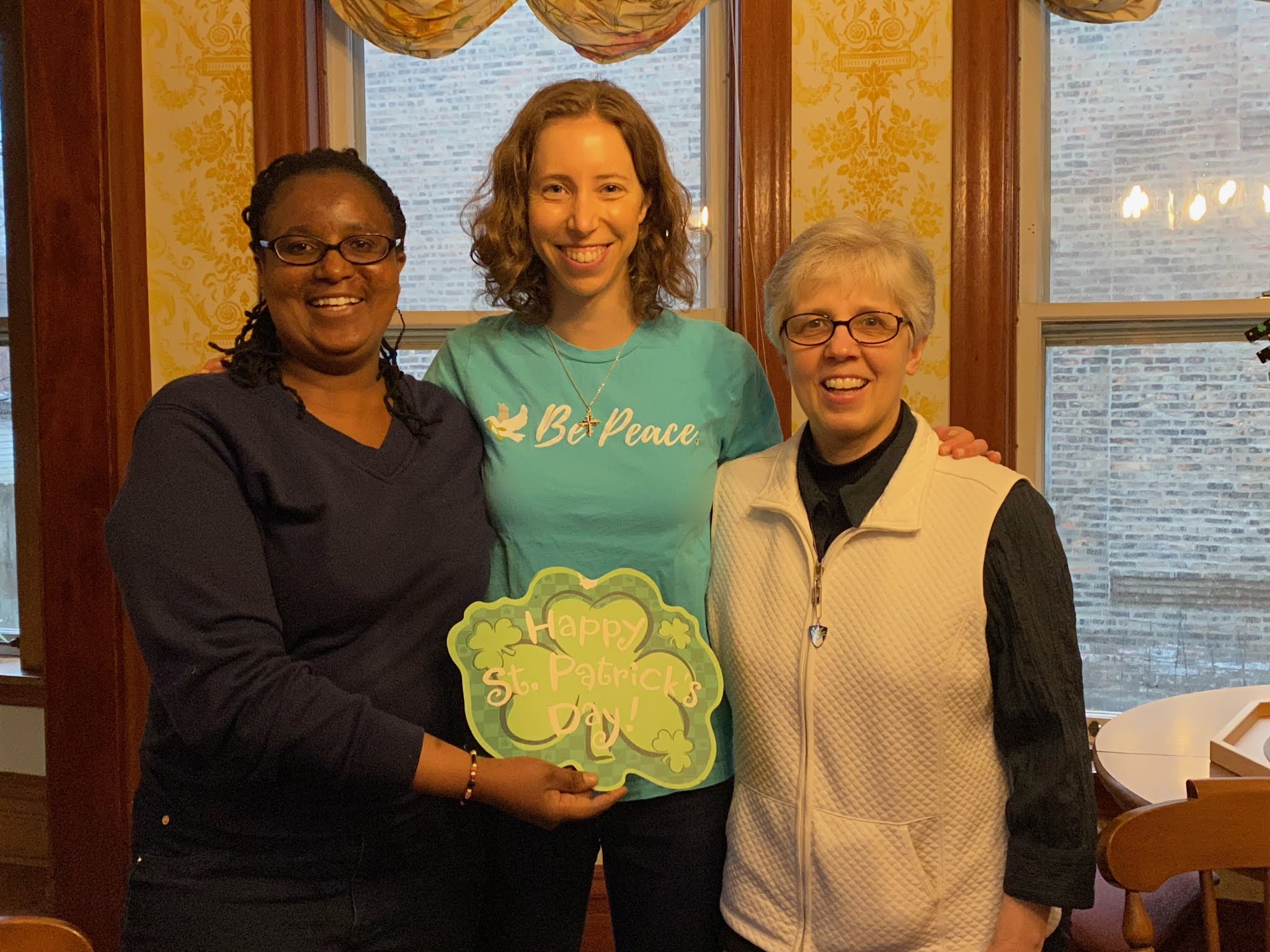
We at the CDN marked the last week of winter in Chicago by celebrating Pi Day, St Patrick's, and early signs of spring. Blessings on the rest of your Lenten season as we prepare for Holy Week!
Over President’s Day weekend, the novices ventured forth on our first overnight outing since August. We headed to the Portiuncula Center for Prayer, which neighbors the motherhouse of the Franciscan Sisters of the Sacred Heart near Chicago. Their fifty-acre property, known as St. Francis Woods, has hermitages for private retreats. When we arrived on Friday, over a foot of snow covered the grounds, and more fell that night as temperatures plunged into the negative degrees.
Lake Michigan in January, when temperatures began to drop in Chicago
Undeterred by the deep freeze, I trekked down to the creek Saturday morning, then spent the afternoon ensconced in my hermitage. The windows faced west toward the woods, so the sun came into view as the hours passed. Shining through tree branches, the light seemed to gain strength as the sun lowered toward the horizon.
Curled under a blanket with apple cider, I read Catherine of Siena’s Dialogue and pondered her image of the Son of God as a bridge. God “made a bridge of the Word” so that humanity might share in the good for which God created us. God reveals to Catherine the Truth “that I created humankind in my image and likeness so that they might have eternal life, sharing in my being and enjoying my supreme eternal tenderness and goodness.”[1]Human beings are destined to share in God’s own being, a Trinitarian being-in-relationship. Jesus Christ, the Incarnate Word of God, communicates that gift of divine life to us by “joining the earth of your humanity with the greatness of the Godhead.” We humans, made from clay, enjoy union with God through Christ, the “bridge [who] stretches from heaven to earth.”
What beautiful and compelling images Catherine offers us! As I sat reading, the lightest of snow began to fall. Like frozen mist, ice droplets hung in the air, shot through with rays of sun. It was as if I could see particles of light shimmering through space, something I had never been able to see before. Dazzled, I closed my eyes against the glory of the light.
Icicles covered the trees along the lakefront when the deep freeze set in
That prayer experience comes to mind this week as the church prepares for the Fourth Sunday of Lent. We read in John’s Gospel the story of the Man Born Blind. After his encounter with Jesus, the Man Born Blind comes to see with eyes of faith. His eyes are opened to belief in Jesus, “the light of the world,” who has come from God to reveal who God is: the source of light and life.
Like the Man Born Blind’s journey of faith, my time at the CDN has led me newly to encounter God-with-us in the mystery of the Incarnation. Going deeper into cosmology and eco-spirituality has opened my eyes to God’s glory made manifest in the world around me. This Lenten season, I want to gaze contemplatively at the unfolding universe and see that all Creation reveals God’s immanent presence, creating and sustaining life. As Catherine of Siena came to see, God’s Incarnate Word unites Earth, humanity, and divinity. God dwells within and around us, like light shimmering in the open air. My wintry vision at the hermitage inspired me to write this poem on the sacrament of Creation:
Christ Self within me, life flares forth.
Love pulses through the universe—attracting force,
heartbeat divine—drawing all things to God.
May I reverence Christ’s immanent Light
in each one I meet,
in the world around me.
Christ kneaded divinity into flesh and clay
like yeast in a loaf of bread.
The heat of divine Love binds us
in a new Creation.
May your eyes behold new visions during this Lenten journey.
This snow creature welcomed us home during the winter months
[1] Catherine of Siena, The Dialogue, trans. Suzanne Noffke. The Classics of Western Spirituality (New York: Paulist Press, 1980), 58-59.
Generosity is not measured by what
we have or how much we give but by the amount of love enshrined in what we
give.
AMECEA image for SCC
http://communications.amecea.org/index.php/2020/04/03/amecea
The visit was intended
to check on Angela’s whereabouts. She made a fancy meal for me. At the end of the meal, it was time for Angela
to bid me goodbye. Angela sent her older son (17 years) for something I did not
know. It was a roaster and some eggs for me. I tried to make her understand
that she needed the eggs more than I did, but she remained excited that she had
something to offer her visitor. In her own words, she said “there is always
plenty for everyone. We don’t run out for being generous. If we don’t give, we
don’t create room to receive.” Partly, this was a cultural practice that required
visitors to be given a good send-off. Perhaps one of the qualities which speak of the nature of God in
contemporary life.
As I enter into this
lent period, I reflect on generosity in line with my encounter with Angela.
Generosity is an inward act of love that does not depend on what we own but, on
the love, we carry with us as we give. As such, generosity should not be a
seasonal thing (lived in Lenten season) but throughout our life. Saint Paul
reminds in 1 Cor 13:2 “if I have a
faith that can move mountains, but does not have love, I am nothing.”
This generosity is not limited to material possession, but as far as the prayers
we offer for others, the quality time we offer to those who lack anyone to
listen to them. As far as the sacrifices we do out of love for our mother
nature. Precisely, there is no single way to be generous. However, there is one
best way to get it done: when it is done out of love.
May this Lenten season be
a moment to contemplate in which areas we are being called to be generous and
share the gift of ourselves with others.
The other night, Annie and I were taking our turn starting up the cars to help prevent the batteries from dying in the cold temps we’re having. As we were doing this, a light, fluffy snow was falling from the sky. Walking down our sidewalk, towards the gate which leads out to where our cars are parked, I paused for a moment to take in the peaceful calm that comes over everything when this type of snow happens. The problem I didn’t see coming as I paused was I now live in Chicago where cars and people are constantly around. As a result, this awaited stillness didn’t come. I was disappointed in city life and thankful to been able to experience the stillness that comes with fresh snow when I was growing up in Wisconsin and when I found myself back in Wisconsin, after 3 years in Phoenix, as a candidate last year.
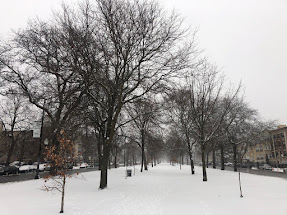
After a recent snowfall (not the big one!) here in Chicago
Walking to the library the next day, thinking about this moment reminded me of the Gospel for the Fifth Sunday in Ordinary Time. In this, we read:
“Rising very early before dawn, he left
and went off to a deserted place, where he prayed.
Simon and those who were with him pursued him
and on finding him said, ‘Everyone is looking for you (Mk 1: 35-37).’” [1]
It seems all Jesus wanted was a moment to step aside and take in God’s beauty and recharge as He prayed-something I was looking for as I paused to take in the calm of the falling snow. As often happens in the Gospel of Mark, the action quickly continues as Jesus is “pursued” as He is trying to get away to pray. Sure, it wasn’t the noise of city life, but I wonder if it cut short the amount of time Jesus had intended to spend in prayer.
A heart to heart moment with my godson on a home visit
during my candidate year.
Isn’t this exactly how prayer often is though? You get settled, ready to take a break from to-do lists and life stressors in order to be with God. Then, a flood of distractions fill the mind as you try to focus on scripture, spiritual ready, journaling, or simple silence in God’s presence. If you’ve never experienced this in prayer, please let me know what your trick is! :D The key during these times, I suppose, is being able to sift through the noise and pay attention to why those things are coming up. Are they truly distractions? Or, are they things God is inviting you to pay attention to and talk to God about during your time together? This year, this is a skill I’ve been fortunate enough to get to intentionally work on during communal prayer because our morning prayer starts with 20 minutes of contemplative prayer. These moments of silence provide an excellent time to check in and see how I’m doing, what God might be inviting me to focus on in a particular way that day, and simply be with my Beloved (how fortunate are we to have the Blessed Sacrament reserved in our chapel!?). Some mornings are easier than others, but in the times when the distractions are stronger than normal I try to remember what Elijah has taught me about learning to pay attention to the deeper levels of my interior life in order to properly listen to the ways God is calling me to rest in God’s love, peace, and mercy.
“Then the LORD said: Go out and stand on the mountain before the LORD;* the LORD will pass by. There was a strong and violent wind rending the mountains and crushing rocks before the LORD—but the LORD was not in the wind; after the wind, an earthquake—but the LORD was not in the earthquake; after the earthquake, fire—but the LORD was not in the fire; after the fire, a light silent sound (1 Kgs 19:11-12).” [2]
Or, as Fr. James Martin, SJ words it in an article Lorraine conveniently sent us as I was working on this blog: “For many people God is often manifested in a feeling of calm. As this happens for you, you can start to recognize what God “feels” like in prayer. St. Ignatius started to see that this was the way God worked in him." [3] In this moment, underneath the noises of life, what “light, silent sound,” what “calm,” is God speaking to you?
Beauty after the first snowfall I experienced at
our motherhouse during my candidate year.
[1]: https://bible.usccb.org/bible/readings/020721.cfm
I look to the Samaritan woman at the well as a model for effective preaching. After her life-changing conversation with Jesus, the woman becomes a witness who invites others from her village to “come and see” Jesus for themselves (John 4: 26, 29). As Dominicans, we want our preaching likewise to draw people into an authentic encounter with Jesus.
I just reread this story closely for my CTU course on the Gospel of John alongside the commentary Life Abounding by Brendan Byrne, SJ. Byrne notes that the woman’s words, literally “Come and see a man who has told me all I have ever done,” can be translated “ ome and see a man who has told me the story of my life.” This rendering captures the depth of her experience of Jesus. Byrne writes, “Jesus has taken the broken fragments of her life and shown that they can be part of a wider pattern of meaning… Running beneath all the disjointed and unsatisfactory aspects of her life has been a story of divine grace” (87). Jesus tells the story of her life as a meaningful narrative set within the wider context of salvation history.
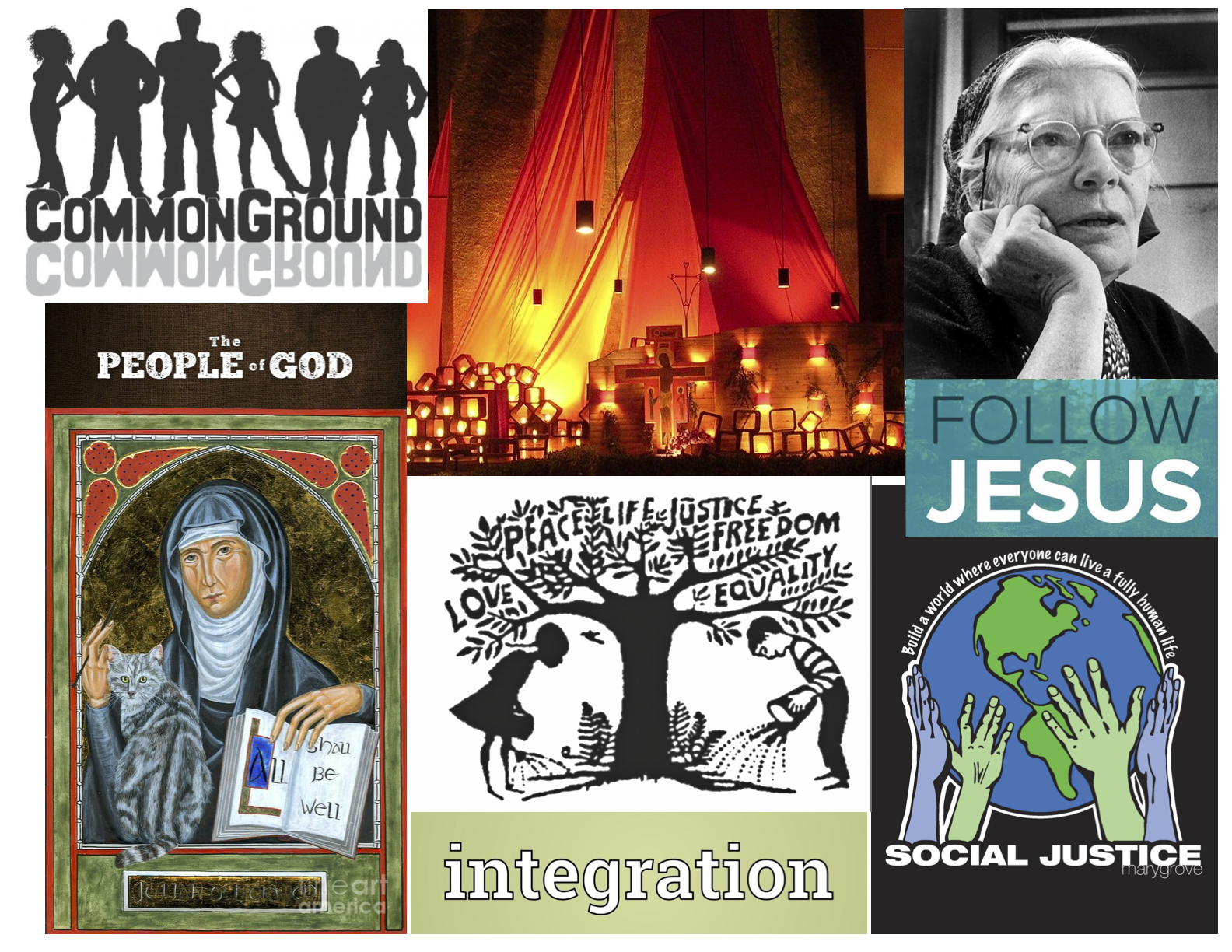
This week I spent time asking Jesus to weave the fragments of my life into a meaningful story of divine grace (Byrne 90). Prompted by Elyse Marie Ramirez, OP, I created a collage of my spiritual journey to share with my fellow novices. Here it is:
To begin, I recalled my high school self. At that time in my life, I wasn’t involved in any religious education program or youth group. I didn’t think being Catholic had much bearing on what I would decide to do with my life. Faith seemed to me a matter of personal morality and family identity. I had a budding passion for social justice and an intuitive sense that all people belong to one human family. I was committed to searching for common ground among peoples of different cultures and backgrounds. It didn’t occur to me that God had anything to do with this.
In college I discovered Catholic social teaching, and it changed my life. Now I had a theological language to articulate principles that I knew in my heart to be true: the dignity of human persons made in the likeness of God, the right to life, the option for the poor and vulnerable, and solidarity with all creation. I learned about Dorothy Day and the Catholic Worker movement, which inspired a commitment to nonviolence. Now I wanted to follow Jesus’ way of peace. I came to understand that peace must be built, by both loving one’s neighbor and working for justice so that all might enjoy equal freedom.
Belonging to the church took on new meaning for me. My faith was no longer simply a private affair. Living out my faith as an adult meant that, by virtue of my baptism, I was responsible for realizing the mission of the universal church. The Spirit has commissioned the church to bring the light of God’s love and life to the world. This vision of the church as the People of God transformed my ideas about what to do with my life. Now I felt that I could most effectively serve the common good through ministry in the church.
However, I had not yet figured out how to sustain this youthful passion for ministry. I still needed to put down spiritual roots and grow into a personal relationship with God. This happened during graduate school when I discovered the Christian mystical tradition and contemplative prayer. Medieval visionaries like Julian of Norwich and other spiritual writers guided my journey into the depths within. I made several pilgrimages to Taizé, the ecumenical monastic community in France, which nurtured a love for silence and a longing for intimacy with God. This thirst for communion with Holy Mystery led me to religious life. I feel that becoming a woman religious integrates my passion for justice and my desire for contemplative living.
What a gift to look back and perceive God’s abiding presence in my life. I’ve ended up in a place—the Collaborative Dominican Novitiate—I never could have imagined in high school. Yet in retrospect I can see that God has accompanied me through every twist and turn along the way, gently calling me on to more abundant life. I’m grateful for this sacred time during the canonical year to discern how God’s grace is giving shape and meaning to my journey. I only hope that telling my story will invite others to “come and see."